

If you want to keep your home healthy and safe in 2025, consider the top indoor air sensor hubs available. The Tapo Smart Monitor offers precise humidity and temperature tracking, while the Eve Room Sensor focuses on VOCs and integrates with Apple HomeKit. For long-range capabilities, check out the YoLink Sensor. The Air Quality Monitor and Zigbee Smart Detector provide extensive air quality metrics. Each option lets you monitor your environment and guarantee ideal living conditions. Discover the best fit for you!
Tapo Smart Temperature and Humidity Monitor (T315)

If you’re looking for a reliable way to monitor your indoor climate, the Tapo Smart Temperature and Humidity Monitor (T315) is an excellent choice. With its 2.7” E-Ink display, you can easily read real-time data on temperature and humidity from any angle. The Swiss-made sensor updates every two seconds, ensuring accuracy within ±0.54°F and ±3% RH. Plus, the device runs on two AAA batteries, lasting up to two years. You can receive alerts for any deviations from your comfort zones, and it integrates seamlessly with the Tapo app for smart home automation, making it a must-have for your space.
Best For: Individuals seeking an accurate and convenient way to monitor indoor temperature and humidity for home automation and comfort management.
Pros:
- Monitors temperature and humidity in real-time with high accuracy.
- Long battery life of up to two years with easy installation options.
- Seamlessly integrates with the Tapo app for smart home automation and alerts.
Cons:
- Requires a separate Tapo Hub for connectivity, adding to the overall cost.
- Some users may find the app complex for accessing historical data.
- Minor discrepancies in humidity readings reported by a few users.
Eve Room Indoor Air Quality Sensor

For health-conscious individuals looking to enhance their indoor environment, the Eve Room Indoor Air Quality Sensor stands out with its advanced VOC monitoring capabilities. It tracks volatile organic compounds, temperature, and humidity, using cutting-edge sensors for accurate, real-time data. With seamless Apple HomeKit integration, you can automate your air quality management—like activating purifiers when needed. The sleek design fits any decor, and the e-ink display provides clear readings. Plus, the Eve app lets you track trends, although some users find it a bit click-heavy. Overall, Eve Room is a smart choice for improving your indoor air quality.
Best For: Health-conscious individuals seeking to enhance their indoor air quality and integrate smart home automation.
Pros:
- Advanced VOC monitoring ensures accurate real-time data for a healthier environment.
- Seamless integration with Apple HomeKit allows for automated air quality management.
- Sleek and minimalistic design fits well with various room decors.
Cons:
- E-ink display visibility can be limited from a distance.
- The Eve app may require multiple clicks to access detailed data.
- Limited compatibility with other smart home systems, such as Google Home.
YoLink Smart Temp & Humidity Sensor with Hub (2 Pack)

The YoLink Smart Temp & Humidity Sensor with Hub (2 Pack) is perfect for anyone looking to maintain ideal indoor conditions, especially wine enthusiasts and parents monitoring nursery environments. With LoRa technology, these sensors can reach up to 1/4 mile in open air, outperforming traditional WiFi and Zigbee options. Enjoy up to two years of reliable battery life, making them ideal for basements or barns. Setup is a breeze via Ethernet or 2.4 GHz WiFi, and you’ll receive timely alerts through push notifications, emails, or SMS. Plus, they’re compatible with Alexa and IFTTT for even more convenience.
Best For: Anyone looking to monitor indoor conditions effectively, particularly wine enthusiasts, parents of young children, and greenhouse owners.
Pros:
- Long-range capability: LoRa technology allows sensors to connect over distances up to 1/4 mile, outperforming WiFi and Zigbee.
- Extended battery life: With up to 2 years of battery life, these sensors provide reliable monitoring without frequent maintenance.
- Versatile alert system: Users can receive alerts via push notifications, emails, or SMS, ensuring timely updates on temperature and humidity changes.
Cons:
- Indoor use only: The sensors are not designed for outdoor applications, limiting their use in certain environments.
- Limited compatibility with Alexa: Functionality with Alexa is restricted to temperature monitoring only, which may disappoint some users.
- Monthly SMS limit: The included plan offers only 20 free SMS alerts per month, which may not be sufficient for high-frequency monitoring needs.
Air Quality Monitor Indoor 5-in-1 CO2 Detector
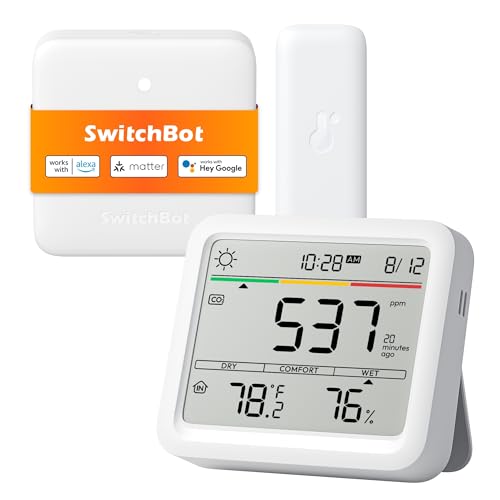
Looking to enhance your indoor air quality monitoring? The SwitchBot Meter Pro CO2 Detector is a 5-in-1 solution that measures CO2 levels, temperature, humidity, time, and date. With a large 92mm display and Swiss-made NDIR sensors, it provides accurate readings every second. You can customize alerts for CO2, temperature, and humidity, ensuring you stay informed. Its portable design allows easy placement in any environment, and it boasts a year-long battery life. With a competitive price of $69 and positive user feedback, it’s a smart choice for maintaining a healthy indoor atmosphere.
Best For: Individuals and businesses seeking a reliable and accurate indoor air quality monitor to track CO2 levels, temperature, and humidity.
Pros:
- Compact and portable design, making it easy to place in various environments.
- Customizable alerts ensure timely notifications about air quality changes.
- Long battery life of up to 12 months, reducing the need for frequent replacements.
Cons:
- Reports of CO2 readings freezing or stopping when plugged in.
- App performance may experience delays in updates and data refreshing.
- Calibration requires outdoor conditions, which may not be convenient for all users.
Zigbee Smart Air Detector (5 in 1 Tester)
Product not found or API error.
Designed for households, offices, and hotels, the Zigbee Smart Air Detector (5 in 1 Tester) is your go-to solution for thorough air quality monitoring. This device checks formaldehyde (HCHO), VOC, CO2, temperature, and humidity in real-time, ensuring a healthy environment. With its built-in sensors, you’ll receive accurate readings and timely alerts if levels exceed preset values. You can also connect it to your ZigBee Hub for intelligent integration with air conditioners, fans, and purifiers. While it has a 3.0-star rating, some users reported calibration issues. The 30-day return policy offers peace of mind for your purchase.
Best For: Individuals and businesses seeking to monitor air quality in real-time, including households, offices, and hotels.
Pros:
- Real-time monitoring of various air quality parameters including formaldehyde, VOC, CO2, temperature, and humidity.
- Intelligent connectivity with smart devices for optimal air quality management.
- Alerts and notifications for preset value exceedance, ensuring timely action for maintaining healthy environments.
Cons:
- Customer feedback indicates potential calibration inaccuracies with the sensors.
- Average customer rating of 3.0 out of 5 stars suggests mixed user experiences.
- Requires a ZigBee Hub for operation, which may involve additional costs or setup.
Haozee Zigbee Temperature and Humidity Sensor
Product not found or API error.
For anyone keen on smart home automation and precise environmental control, the Haozee Zigbee Temperature and Humidity Sensor stands out as an excellent choice. This compact device requires a Zigbee Hub for operation and pairs effortlessly with Home Assistant through Zigbee2mqtt. With high-precision sensors, it delivers real-time temperature accuracy within 0.3 degrees and humidity accuracy within 3%. Its ultra-low power consumption guarantees a long battery life of about six months. Installation is a breeze, allowing for versatile placement in various settings. Users generally report reliable performance, making it a solid option for effective home monitoring and automation.
Best For: Home automation enthusiasts looking for reliable temperature and humidity monitoring solutions.
Pros:
- High-precision sensors provide accurate temperature and humidity readings.
- Easy installation and quick pairing with Zigbee hubs for seamless integration.
- Long battery life of approximately six months, ensuring minimal maintenance.
Cons:
- Update frequency may be slow, affecting real-time monitoring capabilities.
- Requires a Zigbee Hub for operation, which may add to initial setup costs.
- Some users may find the mini design limits placement options in larger spaces.
Airthings Wave Mini Indoor Air Quality Monitor
Product not found or API error.
The Airthings Wave Mini Indoor Air Quality Monitor is ideal for health-conscious individuals who want to maintain a safe and comfortable living environment. This sleek, battery-powered device measures VOCs, humidity, and temperature while evaluating mold risk. With Bluetooth connectivity, you can easily track air quality via the Airthings app on your smartphone. The color-coded indicator helps you quickly grasp your air quality status, and the web dashboard offers detailed insights over time. While it requires a hub for continuous data, its user-friendly features and reliable monitoring make it an excellent choice for enhancing indoor air quality.
Best For: Health-conscious individuals seeking to maintain a safe and comfortable indoor environment.
Pros:
- Comprehensive monitoring of VOCs, humidity, and temperature.
- User-friendly app with real-time tracking and color-coded air quality status.
- Reputable manufacturer known for accuracy and reliability in air quality monitoring.
Cons:
- Requires an expensive hub for continuous data recording.
- Lacks carbon monoxide detection capabilities.
- No Wi-Fi connectivity for remote monitoring without a hub.
Factors to Consider When Choosing Indoor Air Sensor Hubs
When you’re choosing an indoor air sensor hub, it’s essential to take into account factors like connectivity options and sensor accuracy. You’ll want a device that fits seamlessly into your smart home system and offers a user-friendly interface. Don’t forget to think about how it gets its power, too, as that can impact its reliability.
Connectivity Options Available
Choosing the right connectivity option for your indoor air sensor hub can considerably impact your smart home experience. Wi-Fi connectivity is ideal if you want to remotely monitor and control your devices through the internet, seamlessly integrating with your existing home network. On the other hand, Bluetooth hubs are easier to set up and pair directly with your mobile devices, though they may have a shorter range. If you live in a larger home or need to connect through obstacles, consider Zigbee hubs, which utilize a mesh network to link multiple devices over longer distances. Additionally, some hubs support extra protocols like Thread or IFTTT, enhancing compatibility with other smart devices and providing more automation options.
Sensor Accuracy and Reliability
Accurate sensors are essential for effective indoor air monitoring, and several factors determine their reliability. Look for devices that report temperature accuracy within ±0.54°F and humidity accuracy around ±3% RH for dependable climate tracking. High-quality sensors, like Swiss-made chips, provide real-time updates every 2 seconds, keeping you informed about your environment. Consistency is also key; multiple sensors of the same model should ideally show readings within ±0.1°F and 1% RH of each other. Calibration can impact accuracy, especially for CO2 readings, so guarantee proper setup and maintenance. Finally, be mindful that battery performance might affect accuracy, as sensors may decrease update frequency to save power while running on battery mode. Choose wisely for the best results!
Power Source Considerations
Power source is a critical factor in selecting indoor air sensor hubs, as it directly influences their functionality and placement. Battery-operated sensors offer a cable-free design, giving you more flexibility in where to place them. However, their lifespan can range from several weeks to two years, which can mean frequent maintenance. On the other hand, hubs requiring a constant power source, like USB or wall outlets, guarantee continuous operation but limit placement options. Remember, the power source can also affect the reliability of readings; battery-powered devices might reduce update frequency to conserve energy. Finally, consider whether you prefer the convenience of recharging versus the hassle of replacing batteries when choosing your ideal sensor hub.
Compatible Smart Home Systems
When considering indoor air sensor hubs, it’s important to confirm they work seamlessly with your existing smart home systems. Check if the hub supports protocols like Zigbee or Apple HomeKit, as some devices may only function with specific hubs. Evaluate the range and connectivity options; some rely on Bluetooth, while others need Wi-Fi or Ethernet for peak performance. Aim for hubs that can handle multiple devices at once, allowing you to monitor air quality throughout your home. Also, look for integration capabilities that enable automated actions based on air quality readings—like activating air purifiers or HVAC systems. Finally, consider the ease of setup and user experience to guarantee smooth operation and access to historical data.
User Interface and App
How intuitive is the user interface of your indoor air sensor hub’s app? A user-friendly app can enhance your experience by giving you easy access to real-time data and historical trends, boosting your engagement and satisfaction. Look for apps that integrate with smart home ecosystems like Apple HomeKit or Zigbee, as this can streamline functionality and enable automation features for a more cohesive experience. Visual indicators, such as color-coded alerts or graphs, make understanding air quality data simpler, helping you react quickly. Avoid apps that require multiple clicks to access detailed data, as this can frustrate you. Finally, confirm compatibility with various devices and platforms, so you can monitor your air quality effortlessly across all your devices.
Data Storage Capabilities
Choosing an indoor air sensor hub requires careful consideration of its data storage capabilities, as these features can greatly impact your ability to monitor air quality over time. Some hubs offer free cloud storage for historical data, while others may have limited or no storage options. Look for devices that allow storage durations of up to two years, which can help you analyze long-term trends and changes. Periodic data summaries can make it easier to assess air quality without digging through extensive logs. Additionally, check if the hub lets you export data to external formats or cloud services for enhanced flexibility. Keep in mind that some devices may limit data update frequency to conserve battery life, affecting the granularity of stored data.
Installation and Setup Ease
After understanding the importance of data storage capabilities, it’s clear that installation and setup ease also plays a significant role in your choice of indoor air sensor hubs. Look for hubs that offer a straightforward installation process, like simple app downloads and device scanning features for quick setup. Make sure the hub provides clear instructions for pairing with sensors, minimizing user intervention for successful integration. Consider hubs that support multiple connectivity options, such as Ethernet or 2.4 GHz Wi-Fi, which enhances flexibility in placement. Additionally, check if the hub allows for wall mounting or versatile placements to optimize space utilization. Finally, evaluate user feedback regarding the setup experience, as positive reviews often highlight ease of connection and minimal troubleshooting needs.
Alert and Notification Features
When selecting an indoor air sensor hub, alert and notification features are essential for maintaining a healthy living environment. Look for sensors that provide real-time alerts for temperature and humidity deviations from your comfort zones, guaranteeing ideal living conditions. Customizable notification systems—such as push notifications, SMS, or email alerts—help keep you informed about air quality issues promptly. Evaluate the frequency of updates; sensors that provide notifications every 2 seconds offer more precise monitoring. Check if the system integrates with smart home automation, allowing alerts to trigger actions like air purifiers or HVAC adjustments. Finally, verify it has long-term data storage capabilities for historical analysis, helping you understand trends and make informed decisions regarding air quality management.
