

If you want to stay ahead of the forecast in 2025, consider top weather stations like the Tempest Weather System, AcuRite Iris models, Sainlogic Wireless, and Ambient Weather WS-2902. These devices boast advanced features like built-in wind meters, Wi-Fi connectivity, and high accuracy. Budget ranges vary, so you’ll find options for every need. Plus, understanding installation and customer support can make a difference. Stick around to discover which model’s right for you!
Tempest Weather System with Built-in Wind Meter and Rain Gauge
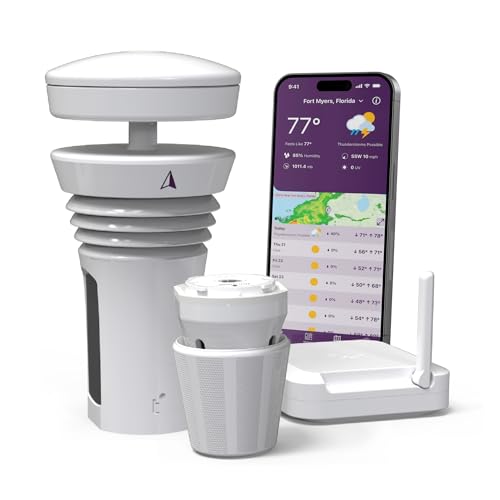
If you’re a weather enthusiast seeking precise and real-time data, the Tempest Weather System is your ideal choice. With its built-in wind meter and rain gauge, you’ll monitor essential metrics like temperature, humidity, and wind speed effortlessly. The solar-powered outdoor sensor sends updates every three seconds, covering over 1,000 feet wirelessly. Thanks to its machine learning technology, you’ll receive accurate forecasts and alerts tailored to your location. Installation is quick, often taking under an hour, and the system integrates seamlessly with smart home platforms. With near-zero maintenance and outstanding customer support, you’ll enjoy a reliable weather monitoring experience.
Best For: Weather enthusiasts seeking precise, real-time data without the hassle of maintenance.
Pros:
- Accurate forecasts and alerts powered by proprietary machine learning technology.
- Quick and easy installation, often completed in under an hour.
- Seamless integration with smart home platforms like Amazon Alexa and IFTTT.
Cons:
- Lacks a dedicated monitor, requiring users to adapt with tablets or other devices.
- Some users may find the initial setup challenging if unfamiliar with technology.
- Limited compatibility with certain older smart home systems.
AcuRite Iris 5-in-1 Wireless Weather Station (01512M)
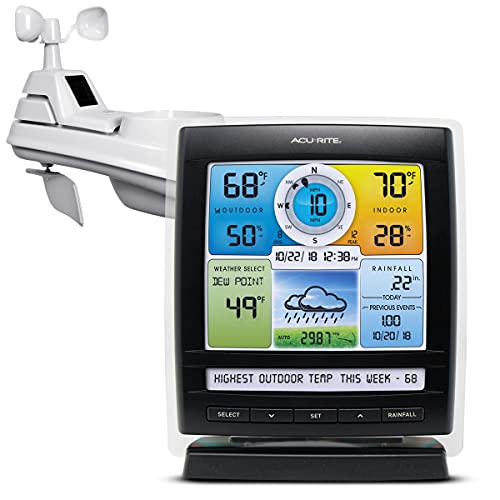
For weather enthusiasts and homeowners who crave accurate, real-time data, the AcuRite Iris 5-in-1 Wireless Weather Station (01512M) stands out as an exceptional choice. It delivers over 55 data points, including temperature, humidity, wind speed, and rainfall, all displayed on a large color LCD. With its self-calibrating feature and 12-hour personalized forecast, you’ll always be prepared. Installation is straightforward, thanks to included mounting hardware, though you’ll need 10 AA batteries. Users love its accuracy and ease of setup, giving it an impressive 4.4-star rating across thousands of reviews. Trust AcuRite for reliable weather insights right at home.
Best For: Weather enthusiasts and homeowners seeking accurate, real-time weather data right at home.
Pros:
- Large color LCD display for easy reading of various weather data points.
- Self-calibrating feature enhances accuracy over time, providing reliable forecasts.
- Positive customer feedback with an average rating of 4.4 out of 5 stars, highlighting ease of setup and accuracy.
Cons:
- Requires 10 AA batteries, which are not included in the package.
- May need a Wi-Fi connection for optimal performance and data transmission.
- Some users may find the initial setup process slightly complex despite included mounting hardware.
AcuRite Iris 5-in-1 Home Weather Station (01540M)
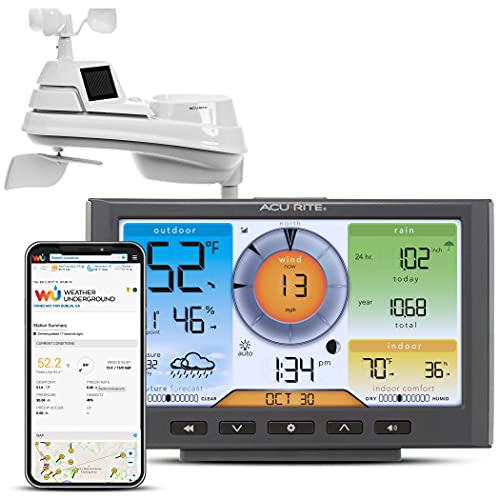
The AcuRite Iris 5-in-1 Home Weather Station (01540M) is perfect for weather enthusiasts who crave thorough data at their fingertips. With Wi-Fi connectivity, you can monitor temperature, humidity, wind speed, and rainfall from anywhere. Its large color LCD display makes it easy to read, while the adjustable dimmer enhances visibility in any light. Setup’s a breeze—just install batteries and mount the outdoor sensor. While it offers accurate measurements, some users have reported mixed experiences with Wi-Fi reliability and data consistency. Still, with over 25 data points, it’s a solid choice for keeping you informed about changing weather conditions.
Best For: Weather enthusiasts who want comprehensive data and remote monitoring capabilities in a stylish design.
Pros:
- Large color LCD display with adjustable dimmer for easy reading in various lighting conditions.
- Wi-Fi connectivity allows for remote monitoring and data sharing with a vast network of personal weather stations.
- Provides over 25 data points for detailed weather analysis, including temperature, humidity, wind speed, and rainfall.
Cons:
- Users have reported mixed experiences with Wi-Fi connection reliability and receiving support.
- Inconsistencies in data and predictions when using Weather Underground functionality.
- Some users suggested improvements, such as clearer instructions and the inclusion of rechargeable batteries.
Sainlogic Wireless Weather Station with Outdoor Sensor

Gardening enthusiasts and outdoor activity planners will find the Sainlogic Wireless Weather Station with Outdoor Sensor an invaluable tool for tracking weather conditions. This 7-in-1 device monitors temperature, humidity, wind speed, rainfall, and more, providing you with accurate data at your fingertips. Its 7.5-inch LCD screen guarantees clear visibility, while wireless connectivity allows placement up to 328 feet away. Setup is a breeze, requiring just three AAA batteries. Although users praise its functionality, the included PC software has some usability issues. Still, its reliability makes it a great choice for anyone passionate about weather tracking and planning outdoor activities.
Best For: Gardening enthusiasts and outdoor activity planners seeking reliable weather tracking.
Pros:
- Easy setup requiring only 3 AAA batteries and minimal technical skills.
- Monitors a wide range of weather conditions with high accuracy.
- Wireless connectivity allows flexible placement up to 328 feet away.
Cons:
- Included PC software has usability issues and poor interface design.
- Limited data export options for advanced analysis.
- Some users report dissatisfaction with the software experience detracting from the overall functionality.
Ambient Weather WS-2902 WiFi Smart Weather Station
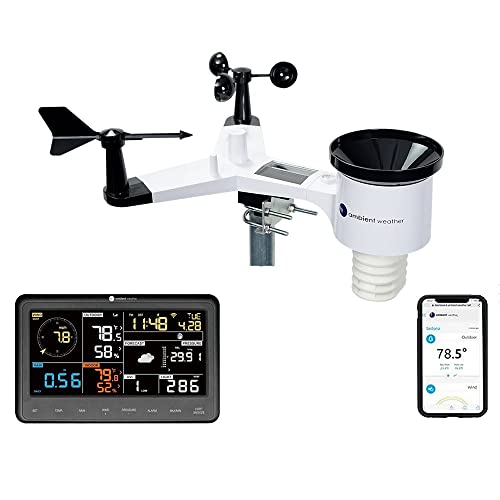
Looking for a reliable weather station that seamlessly integrates with your smart home? The Ambient Weather WS-2902 WiFi Smart Weather Station offers an Osprey Sensor Array, delivering precise data on wind speed, temperature, humidity, and more. You can access hyper-local weather insights through your smartphone or smart devices like Google Home and Alexa. Setup’s a breeze, though you might need mounting hardware. While most users report accurate predictions, some have noted issues with wind speed limits and display visibility. Join a community of weather enthusiasts to share your findings and stay ahead of the forecast!
Best For: Weather enthusiasts looking for accurate, hyper-local data who also want smart home integration.
Pros:
- Accurate readings for various weather conditions.
- Easy installation with community support for troubleshooting.
- Detailed weather analytics available through multiple platforms.
Cons:
- Display visibility can be poor from certain angles.
- Wind speed readings max out at 99.9 mph, which may be limiting.
- Occasional reception issues and challenges with Daylight Savings Time settings.
AcuRite Iris 5-in-1 Wireless Weather Station (01512M)
For anyone seeking precise, hyperlocal weather insights, the AcuRite Iris 5-in-1 Wireless Weather Station (01512M) stands out as an ideal choice. It delivers over 55 data points, including temperature, humidity, and wind speed, all displayed on a large color LCD screen. With real-time readings and a personalized 12-hour forecast, you’ll always be prepared. The station self-calibrates for improved accuracy, and after 14 days, it offers reliable predictions. Customers rave about its easy setup and accurate readings, earning it a solid 4.4-star rating. Plus, AcuRite’s warranty guarantees you receive excellent customer support when needed.
Best For: The AcuRite Iris 5-in-1 Wireless Weather Station is best for weather enthusiasts and homeowners seeking accurate, real-time weather data for personal use.
Pros:
- Comprehensive Data: Provides over 55 data points including temperature, humidity, wind speed, and rainfall.
- User-Friendly Display: Features a large color LCD screen for easy reading of current weather conditions.
- Self-Calibrating Accuracy: Improves pressure accuracy over time and offers reliable weather predictions after 14 days.
Cons:
- Battery Requirement: Requires 10 AA batteries, which are not included, adding to the initial setup cost.
- Limited Operational Range: The temperature range is confined to 32°F to 120°F, which may not suit extreme climates.
- Wi-Fi Dependency: Connectivity issues may arise if the Wi-Fi signal is weak or unstable in certain areas of the home.
Weather Station Wireless Indoor Outdoor Thermometer

Tailored for those who prioritize accuracy and convenience in weather monitoring, the Weather Station Wireless Indoor Outdoor Thermometer stands out with its high-precision sensors that track a wide temperature range. You can monitor outdoor temperatures from -40°F to 158°F and indoor temperatures from 14°F to 122°F. With a wireless range of up to 330ft, it updates every 30 seconds for timely info. The large 4-inch LCD display shows essential data, including humidity and weather forecasts. Setup is a breeze, and you’ll appreciate the adjustable brightness. Overall, it’s a reliable and affordable choice for your weather monitoring needs.
Best For: Those seeking an accurate and convenient weather monitoring solution for both indoor and outdoor environments.
Pros:
- High-precision sensors track a wide temperature range from -40°F to 158°F outdoors and 14°F to 122°F indoors.
- Large 4-inch LCD display with adjustable backlight for easy readability.
- Wireless range of up to 330ft with updates every 30 seconds for timely information.
Cons:
- Lacks some advanced features found in higher-end models.
- Alarm feature may not be utilized by all users.
- Only one sensor included, limiting multi-location monitoring unless additional sensors are purchased.
Factors to Consider When Choosing Weather Stations
When you’re choosing a weather station, you should consider factors like data accuracy and connectivity options. The ease of installation and clarity of the display can also impact your experience. Plus, think about the specific weather features and metrics you need for your local conditions.
Data Accuracy and Precision
Choosing a weather station involves carefully considering data accuracy and precision, as these factors greatly impact the reliability of the information you’ll receive. Look for temperature readings within ±1.1 degrees Celsius, covering a range from sub-zero to over 120 degrees Fahrenheit. Advanced models utilize machine learning and self-calibration methods to enhance pressure accuracy by analyzing thousands of readings over time. For rainfall, high-quality sensors can measure as little as 1/10th of an inch, vital for tracking precipitation. Additionally, humidity sensors should operate within 1% to 99% for accurate readings in varying conditions. Finally, remember that calibration is essential; many stations need adjustment after installation to guarantee they maintain ideal accuracy over time.
Range and Connectivity Options
How far can your weather station’s sensors reach? The wireless range of weather stations varies greatly, with some models extending connectivity up to 1,000+ feet. This flexibility allows you to place outdoor sensors far from the indoor display unit. Many weather stations also use Wi-Fi connectivity, letting you access real-time data remotely and integrate with smart home platforms for added automation. If you need to monitor multiple locations, look for models that support several sensors. Keep in mind that signal reliability can be affected by obstructions and interference from other devices. So, consider placement carefully to guarantee accurate data transmission and peak performance.
Installation and Setup Ease
A smooth installation process can make all the difference when setting up your weather station. Look for models that promise quick setup times, ideally under an hour, to avoid frustration. Easy Wi-Fi connectivity through dedicated apps simplifies pairing the station with your home network. Make sure the device comes with all necessary mounting hardware and clear instructions, especially for outdoor sensors. Additionally, check if the station maintains reliable connectivity in challenging environments, like high locations or near metal surfaces. Finally, opt for stations that minimize battery replacements, such as solar-powered models or those with rechargeable battery systems. By prioritizing these features, you’ll enjoy a hassle-free setup and reliable weather data.
Display Clarity and Usability
When it comes to weather stations, display clarity and usability can greatly enhance your experience. A large color LCD display makes it easy for you to read indoor and outdoor temperature, humidity, and other data at a glance. Look for models with adjustable backlighting, ensuring clear visibility in bright sunlight or dim conditions. User-friendly interfaces featuring intuitive icons and layouts help you understand forecasts without needing technical know-how. Some stations even let you customize the display to highlight your preferred data points. Additionally, the ability to show real-time updates every 30 seconds or more keeps you informed with timely and relevant information. Prioritizing these features can make monitoring the weather a breeze!
Weather Features and Metrics
Choosing the right weather station involves considering various features and metrics that can greatly impact your understanding of local conditions. Look for stations that provide essential data like temperature, humidity, wind speed and direction, barometric pressure, rainfall, UV index, and solar radiation. Advanced models can offer over 55 data points, enabling detailed analyses of weather patterns and historical trends. Accurate temperature readings, typically within ±1 to ±2 degrees Celsius, are vital for forecasting. Pay attention to rain gauges that utilize machine learning technology for improved accuracy. Additionally, monitoring capabilities that send alerts for severe weather events, such as lightning strikes or extreme winds, can enhance your safety during outdoor activities. Choose wisely to stay informed and prepared.
Power Source and Sustainability
Understanding weather features and metrics is just one part of selecting the right weather station; power source and sustainability also play an essential role. You’ll find that weather stations can be powered by solar panels, batteries, or AC power. Opting for solar-powered models promotes sustainability, reduces battery waste, and minimizes maintenance. However, keep in mind that these require direct sunlight for peak performance. Battery-operated stations might need frequent battery replacements, which can contribute to environmental concerns if not disposed of properly. Some models offer the flexibility of multiple power sources, allowing you to adapt based on your specific needs. By choosing a weather station with a sustainable power source, you enhance its reliability, longevity, and contribute to energy conservation efforts.
Price and Value Comparison
Price is an essential factor in selecting a weather station that meets your needs and budget. Weather stations range from under $50 for basic models to over $500 for advanced systems. Higher-priced options often come with more sensors, like wind speed and rainfall measurements, providing better accuracy for serious enthusiasts. Consider the long-term value, including durability and maintenance costs; some units require less upkeep and perform better over time. Features like Wi-Fi connectivity and smart home integration are common in mid to high-range stations, enhancing their appeal. Don’t forget to assess warranty and customer support, as reliable service can greatly impact the overall value of your weather station investment. Choose wisely to get the best bang for your buck.
